Why Window Treatments Matter More in Central Florida
Relentless sun, heat and humidity make the right window treatments a comfort and energy decision in Central Florida, not just a finishing touch.

In this guide
If you have ever walked past a south-facing window at 3 p.m. in July and felt the heat radiating off the glass, you already understand why the window treatments central florida homeowners choose are doing far more work than they would almost anywhere else in the country. In Orlando and the surrounding cities, your shades and shutters are not just a decorating decision they are a daily defense against intense UV, brutal afternoon heat gain, sticky humidity, and the kind of low-angle glare that washes out a TV and fades a sofa. The question is not whether to cover your windows. It is which approach actually holds up to a Central Florida summer.


What Window Treatments Central Florida Homes Really Need
Orlando sits at roughly 28 degrees north latitude, which means the sun climbs high and stays harsh for most of the year. We get more than 230 sunny days annually, summer afternoons that push past 95 degrees with a heat index well above that, and humidity that lingers from May into October. A window that looks lovely in a showroom behaves very differently when it spends six months absorbing direct subtropical sun. That is the real reason the right covering pays for itself here: it intercepts solar energy before it turns your glass into a radiator.
Bare glass is the leak you can see
On an uncovered window, solar heat gain pours straight into the room and your AC fights it all afternoon. The goal of a good treatment is simple: stop heat at the glass instead of paying to remove it after it has already arrived inside. That single shift is what separates a comfortable Lake Nona living room from one where the thermostat never seems to win.

Heat, energy bills, and the case for the right covering
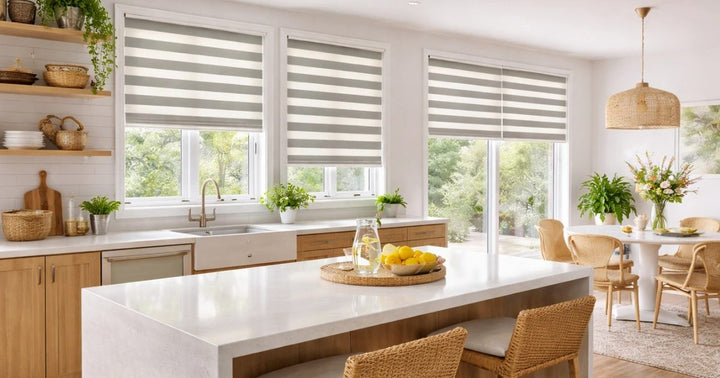
In a climate like ours, windows are one of the biggest sources of unwanted heat in the home. The covering you choose directly affects how hard your air conditioner has to run during the long cooling season. Cellular (honeycomb) shades trap a layer of air that slows heat transfer; solar shades cut glare and UV while keeping your view; and plantation shutters add a solid, insulating barrier you can angle through the day. That is why so many homeowners invest in custom window blinds in Orlando sized to each opening, because the best fit depends on the room, the exposure, and how you live in the space which is exactly what a free in-home visit is for.
What window treatments actually do in our climate
Different exposures call for different answers. East-facing bedrooms in Oviedo or Winter Springs benefit from room-darkening or blackout layers that hold off the early sunrise. West-facing great rooms in Windermere and Dr. Phillips take the worst of the afternoon, so glare control and heat rejection matter most there. Browse our window treatments to see how shades, shutters, and layered combinations each handle a specific job rather than treating every window the same.
Humidity, fade protection, and choosing materials that last
Central Florida humidity is hard on the wrong materials. Real-wood louvers can warp or swell in a steamy bathroom or a sun-baked lanai slider, which is why composite and faux-wood shutters are so popular here they shrug off moisture and hold their finish. Fabric matters too: a cheap liner will fade and grow brittle after a couple of summers of direct sun, while quality solar and room-darkening fabrics are engineered to take the UV beating. This is also where it pays to think of your whole home as a system, the same way you would when planning custom storage the right material in the right spot lasts, and the wrong one becomes a callback.

Layering is the local secret
Many of our Winter Park and Baldwin Park clients land on a layered setup: a solar shade or sheer for the day that keeps the view and kills glare, paired with a room-darkening shade or drapery for sleep and privacy at night. One window, two completely different jobs handled without compromise.
Safety, kids, and modern operating systems
If you have young children or pets, cord safety should be part of the conversation from the start. We strongly recommend cordless and motorized operating systems, which align with current CPSC child-safety guidance by removing accessible pull cords entirely. Cordless cellular shades, motorized rollers, and remote- or app-controlled scenes also make tall great-room windows and hard-to-reach lanai transoms genuinely practical you set them once and let them run on a schedule that follows the Florida sun.
Why the climate raises the stakes
There is also the durability factor. Window coverings are not a yearly purchase, so the value is in choosing something built for our conditions the first time. Ask about warranty terms and operating-system options when you compare quotes a slightly higher up-front cost for moisture-stable materials and a quality motor often means years of trouble-free use instead of a fade-and-replace cycle. The same long-game thinking applies whether you are outfitting windows or planning garage and storage for a growing family.
- In Central Florida, window treatments are a comfort and energy decision first, a decor decision second.
- Match the covering to the exposure: insulate west and south rooms, darken east-facing bedrooms.
- Choose moisture-stable materials (composite shutters, quality fabrics) for our humidity and sun.
- Go cordless or motorized for child safety and for tall, hard-to-reach windows.
- Layering a solar shade by day, room-darkening by night solves the most rooms at once.
“Here, your windows work harder than your walls. The right covering is the difference between fighting the sun all afternoon and barely noticing it.”
Every home and every window is different, and the only way to get it right is to see the rooms, the exposures, and how the light moves through your day. The fastest path is to book a free in-home visit no obligation, just honest guidance on what will perform in your space. You can also reach our Orlando team directly at +1-407-250-9373.