The Best Blinds for Orlando’s Humidity (and What to Avoid)
Orlando humidity warps the wrong blinds fast. See which materials survive, what to avoid, sample pricing, and the best picks for every room.

In this guide
If your shades warp, your slats sag, or your wood shutters peel after a single Orlando summer, you already know the truth: choosing blinds for humidity is a different decision here than almost anywhere else in the country. Central Florida stacks 90-degree heat, daily afternoon storms, and indoor moisture from cooking and showers on top of a months-long humid season. The right window treatment shrugs all of that off for a decade; the wrong one quietly self-destructs. This guide walks you through what actually holds up in homes from Lake Nona to Winter Park, what to skip, roughly what each option costs, and how to compare the moisture-safe lines we install.
What Orlando humidity does to a window treatment
Choosing blinds for humidity: what really drives the decision
Three things decide whether a window treatment survives Florida: the material, the room, and how much direct light and heat the window takes. A north-facing window in a dry bedroom can wear almost anything. A west-facing kitchen window over the sink, or a frosted window inside a steamy Dr. Phillips master bath, needs something engineered to ignore moisture entirely — which is exactly why our custom window blinds in Orlando are built to the room rather than bought off a shelf. Price follows durability: the materials that laugh off humidity cost a little more up front and save you a full replacement five years early.
Material is 80% of the answer
For wet and high-heat windows, look for the words faux wood, composite, poly/vinyl, or aluminum. These don't absorb water, so they can't warp, swell, or grow mildew. Real wood and untreated bamboo look gorgeous but belong on dry, shaded windows only — over a kitchen sink or in a bathroom, Orlando's moisture will find them within a season or two.

Match the room to the material
Here is the part most big-box buyers miss: the slat or shutter is only half the product. Hardware matters just as much. In humid homes we steer clients toward rust-resistant components and, in coastal-adjacent or pool-heavy areas, sealed mechanisms that won't seize. We cover all of this during a free in-home visit so the recommendation fits your actual windows, not a catalog average.
Why moisture-resistant pays off in Florida
Sample pricing by material (per standard window, installed)
Exact pricing depends on window size, mount type, and finish, which is why we quote after seeing the space. The takeaway: the moisture-proof options sit in the middle and upper tiers, but they're the ones you don't replace early. Spreading a slightly higher cost over 10-plus years usually beats re-buying cheap vinyl twice.
Good, better, best: the options that actually survive

Good — faux wood blinds
The workhorse of humid Florida. Faux wood mimics the look of painted wood slats but is made of moisture-proof composite or PVC. It won't warp over a sink, won't peel in a bathroom, and wipes clean with a damp cloth. If you want one safe answer for most rooms in the house, this is it — and it's friendly on the budget.
Better — composite plantation shutters
Faux (composite) plantation shutters are the upgrade pick: a built-in, architectural look that adds resale appeal and never warps. They insulate against heat, block afternoon glare, and tolerate steam, which makes them a favorite for bathrooms and west-facing rooms in Windermere and Dr. Phillips. Solid, low-maintenance, and timeless.


Best for sun control — solar & roller shades
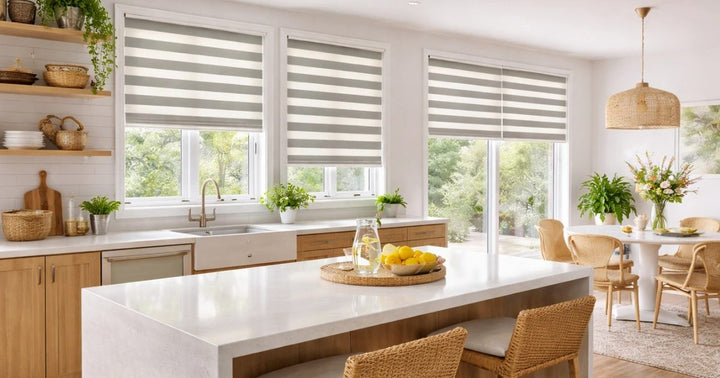
When the real enemy is glare and heat — think sliders facing a pool or a Lake Nona great room flooded with light — PVC-coated solar shades cut UV and brightness without trapping moisture. They come in openness factors that keep your view while taming the afternoon sun, and the coated fabrics don't host mildew like untreated cloth can.
“In Orlando, the cheapest blind is rarely the cheapest decision — moisture-proof materials simply don't ask to be replaced.”
What to avoid in a humid home
- Real wood blinds or shutters over kitchen sinks, in bathrooms, or in unconditioned sunrooms — they swell and peel.
- Untreated bamboo or paper shades in steamy rooms — they spot and curl.
- Bargain vinyl with thin, non-rust hardware — the mechanism fails long before the slats do.
- Heavy, non-treated fabric shades right next to a shower — they hold moisture and can mildew.
Who each option is for
For child safety, ask us about cordless and motorized lift options — the CPSC strongly recommends cordless window coverings in homes with young kids, and most of our humidity-safe lines offer them. We'll also walk you through warranty terms for each material so you know exactly what's covered before you decide. You can browse the full range on our window treatments collection or compare looks in person during a no-pressure visit.
- For wet or hot windows, choose faux wood, composite, vinyl, or aluminum — never real wood or bamboo.
- Composite plantation shutters are the most durable, highest-resale upgrade.
- Solar/roller shades win when glare and heat — not privacy — are the problem.
- Spend on hardware too: rust-resistant mechanisms outlast the slats.
- Ask about cordless/CPSC child-safe options and warranty terms before you buy.
We replaced builder-grade blinds that warped in two summers with faux wood shutters — three years in, they still look brand new.— Homeowner, Winter Park
Every home in Central Florida has its own mix of sun, steam, and style, so the smartest move is to let a designer see your windows in person. We'll recommend the exact material and hardware for each room, show samples in your light, and give you a clear, itemized quote — no guesswork on your end, just the right blinds for humidity that will still look great a decade from now. Prefer to talk it through first? Call us at +1-407-250-9373.