

Craft Room Storage Ideas: How to Organize a Spare Room, Loft or Closet
Turning a spare bedroom, loft or closet into a craft or sewing room? Here's how to plan the drawers, work surface, wall storage and humidity protection so every supply is easy to find and use.

In this guide
Most craft rooms start out as piles. The fabric is in the guest closet, the paper is in a plastic tote, the sewing notions are in a coffee can and the cutting mat is behind the couch. Projects stall because the first twenty minutes go to looking for things. Good craft room storage ideas fix that by giving every supply a set place near where you use it, so you can sit down and get started.
In Orlando-area homes the hobby room is usually a spare bedroom, a loft over the garage or a reach-in closet that got taken over. A craft room uses the same cabinetry and drawers we already build for closets, pantries and offices. This guide covers the questions that matter most: drawers or bins, how high the work surface should be, how to use the walls, how to protect paper and fabric from Central Florida humidity, and how to share the room with guests or a home office.
Plan for one room and one hobby
A quilter needs long, flat surfaces and shelves for fabric. A scrapbooker needs flat paper storage and lots of small drawers. A jewelry maker needs shallow trays and good light. Before you choose any cabinet, write down the hobby you do most and the supplies it uses. We start every custom closet design the same way: list what you own, then build around it.

Craft Room Storage Ideas for Small Supplies: Shallow Drawers or Bins?
This is the first decision, and the answer is usually both, with each one holding different supplies. Shallow drawers are best for small, flat things you want to see at a glance, like buttons, thread spools, stamps, washi tape, beads and pens. When you open the drawer, everything sits in one layer and nothing gets buried. Bins and baskets are better for bulky, soft or oddly shaped things like yarn skeins, batting, stuffing and seasonal décor supplies.
A good layout puts a bank of shallow drawers within arm's reach of your seat. Deeper drawers and labeled bins go on the higher shelves and in the lower cubbies. Drawer dividers and inserts, like the ones in closet jewelry drawers or pantry spice drawers, stop tiny pieces from sliding into a jumble every time the drawer closes. Label the drawer fronts too. Once a project is spread across the table, a label lets you put things back without having to think about it.
What Height Should Your Craft Work Surface Be?
No single height is right for everyone. It depends on whether you sit or stand while you work. Measure your own body instead of using a catalog number: sit or stand the way you work and note where your elbows fall.
- Standing work (fabric cutting, rotary cutting, wrapping, assembling large pieces): a counter-height surface lets you lean over the work without bending your back. Many quilters like a cutting island they can walk all the way around.
- Seated machine sewing: the machine bed should sit close to your elbow height when you're seated. That often means a surface lower than a standard desk, or a drop-in platform.
- Seated detail work (paper crafts, jewelry, painting): a desk-height surface with knee space and a good task light works for most people.
- Two hobbies, two heights: if you both sew and cut, plan two surfaces. For example, put a seated sewing desk on one wall and a standing cutting counter on another. One in-between height won't suit either job.
“Measure the work surface to your elbows, not to a catalog. The right height is the one that lets you craft for an hour without a sore back.”
Using Wall Storage for Tools, Fabric and Rolls
A spare bedroom runs out of floor space quickly, so the walls have to hold most of the storage. Floor-to-ceiling cabinetry gives you three zones. Closed storage up high holds what you use once a season, open shelving at eye level holds what you reach for every week, and drawers below the work surface hold daily supplies.

Make the walls work
Fabric bolts fold neatly onto open shelves sized to their width, so every color stays visible. Rolls of wrapping paper, vinyl and kraft paper can stand upright in tall, narrow cubbies or lie flat in dowel-style holders. Scissors, rulers and rotary cutters hang on a pegboard or rail panel above the cutting surface. Our home office built-in ideas for spare rooms, lofts and corners show more wall-built layouts, and craft rooms follow the same approach.
Wall storage that earns its space
Keeping Paper and Fabric Dry in Central Florida Humidity
Orlando's humid air is hard on craft supplies. Paper curls, cardstock warps, fabric can pick up a musty smell and metal notions can tarnish. Protecting them takes a few habits and the right kind of storage, not special equipment.
- Keep supplies inside the air-conditioned house. A garage or an unconditioned attic is the wrong place for paper and fabric.
- Store paper flat in closed drawers instead of upright in open bins. It stays covered and won't bow.
- Keep fabric stashes in closed cabinets with doors, and leave a little space between folded pieces so air can move.
- Don't push storage tight against an exterior wall that gets afternoon sun. Keep the air conditioning running so the room's temperature and humidity stay steady.
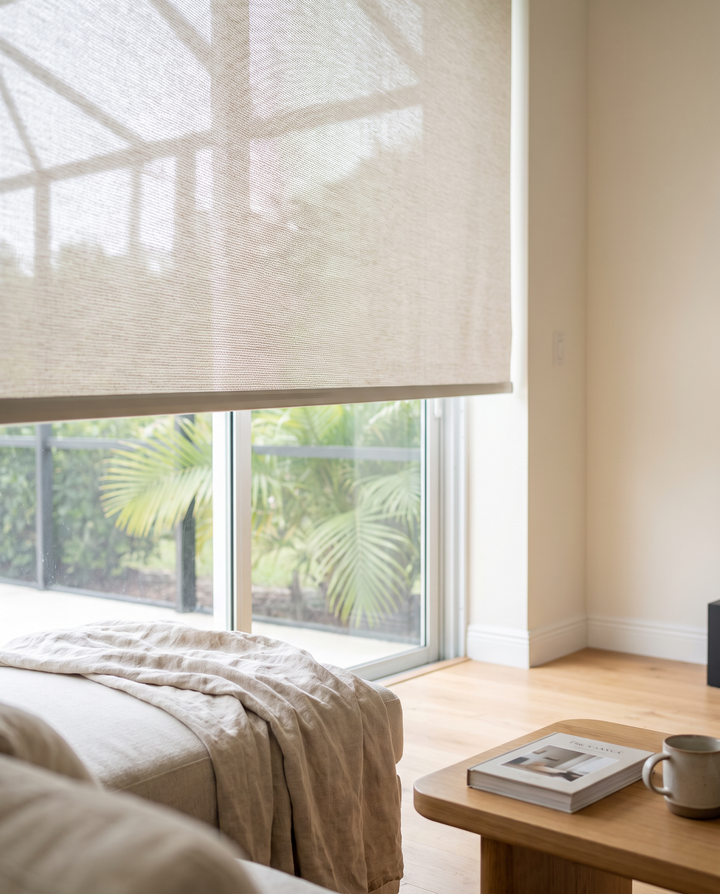
- Limit direct sun, which fades fabric and thread. Light-filtering roller or cellular shades help. Our guide to the best window treatments for Orlando sun and heat covers the options. We also offer custom window blinds and shades in Orlando in cordless versions, which the CPSC recommends for any home with young children or pets.
If you plan to add shades to a craft room window, decide on the mount before you measure. An inside mount sits within the window frame for a clean, built-in look, but it needs enough frame depth. An outside mount covers the frame and the wall around it, which blocks more light at the edges, and that helps protect fabric and thread from fading. For an inside mount, measure the width at the top, middle and bottom. For an outside mount, add overlap on each side. Measure twice either way, or have us measure at the design visit.
Light-filtering shades for a craft room
We build our craft room cabinetry from the same EGGER thermally fused laminate we use for closets, pantries and offices, and it comes in 96 EGGER finishes. Glue, glitter and chalk dust wipe off the surface. If you're comparing materials, read closet materials compared.
Craft room cabinetry at a glance
Fitting a Craft Station Into a Guest Room, Office or Closet
Most Orlando families don't have a room to give over to one hobby. The craft space shares the room with a guest bed, a work-from-home desk or both. In a shared room, the best craft room storage ideas use storage that closes up, so the room can switch roles quickly.
Close it up when guests arrive
A wall of cabinetry with doors can hide a sewing machine, fabric and works in progress, then open up when you're ready to make something. In a shared office, one run of cabinets can hold files on one side and craft drawers on the other, with one desk for both. Our home office cabinets and bookshelves use the same drawers, shelves and doors, so the office and the craft corner match.

A reach-in closet can be a full craft station on its own. Take off the bifold doors and add a desk-height counter across the opening, with shallow drawers below and shelves above. With new doors in front, the whole workspace disappears when you close them. Our guide on how to replace bifold closet doors covers the door options. A loft works much the same way, with low cabinets under the sloped ceiling and a long counter along the railing side.
How to plan your craft room storage
- Sort your supplies by hobby and by how often you use them: daily, weekly or seasonally.
- Measure the room or closet wall by wall, and mark windows, outlets and vents. Measure twice.
- If the room has a window that needs shades, choose inside or outside mount first, then measure for that mount.
- Decide whether you sit, stand or do both, and note your elbow height for each.
- Assign zones: shallow drawers beside the work surface, open shelves at eye level and closed cabinets up high.
- Plan for sharing. If the room doubles as a guest room or office, add doors that close over the craft zone.
- Book a design visit so you can see the layout in 3D before anything is built.
At our free in-home design consultation, we measure the space, talk through your hobby and create a 3D design with a fixed, itemized quote. Most home offices and bookshelves are installed in one to two days, and multi-wall builds can take two to three. A craft room is the same kind of build. To see what the visit is like, read what to expect at a design consultation.
- Plan the room around one main hobby and the supplies it uses.
- Use shallow drawers for small, flat supplies and bins for bulky, soft ones.
- Set the work surface to your elbow height: counter height for standing work, lower for seated sewing.
- Use the walls: open shelves for fabric, tall cubbies for rolls and rails for tools.
- Keep paper and fabric in closed storage inside the air-conditioned house, away from direct sun.
- For window shades, choose inside or outside mount before measuring, measure twice and go cordless.
- In a guest room or office, choose cabinetry with doors so the craft zone closes up.
Made to measure
Explore the styles
- Walk-In ClosetWalk-In ClosetsHanging, drawers and shelves around the room, planned for everything you own.View details
- Master ClosetMaster ClosetsThe primary suite’s dressing room: island, lighting, glass and display.View details
- Reach-In ClosetReach-In ClosetsDouble or triple the storage of a standard closet.View details
- PantryPantry CabinetsPull-outs, adjustable shelves and a place for everything in the kitchen.View details


Frequently asked questions
Are drawers or bins better for craft supplies?
How high should a craft table be?
How do I protect paper and fabric from Florida humidity?
Should craft room shades be inside or outside mount?
Can a closet be turned into a craft station?
How long does it take to install craft room cabinetry?
Keep reading
All of Design & Buying Guides-
 Design & Buying Guides
How to Clean Fabric Shades Without Ruining Them: An Orlando Care Guide
Oct 30, 2026
-
 Design & Buying Guides
How to Declutter a Closet Before a Remodel (So the New System Fits What You Own)
Oct 26, 2026
-
 Design & Buying Guides
Butler's Pantry Ideas: What Goes In One and How to Fit It Into an Orlando Home
Oct 26, 2026
